Beyond TAK Integration: Turning Verified Identity Into Better Situational Awareness
TAK was designed to integrate.
Its open architecture is one of the reasons the Team Awareness Kit has become such a powerful platform for public safety mapping, situational awareness, and disaster response. The U.S. Government’s TAK program supports third-party development and integrations that allow external software, hardware, sensors, and other technologies to contribute information to the TAK environment.
But connecting another system to TAK is only part of the challenge.
The quality of the common operating picture depends heavily on the quality of the information being passed into it.
A third-party platform may be able to send a user’s location to TAK. But does it know enough about that user to tell TAK what that dot should represent?
What type of agency does the responder belong to?
What discipline do they represent?
What is their role?
How should their callsign be formatted?
Most importantly for statewide deployments, how should they appear on the map according to the state’s TAK standards?
That is where the Bridge4PS integration with TAK is fundamentally different.
Because Bridge4PS maintains verified public safety identities and captures organizational and role metadata as part of its nationwide public safety network, the integration can provide TAK with more than a location.
It can provide the context needed to automatically apply the state’s established mapping conventions.
For statewide TAK programs, that turns identity into situational awareness.
TAK Can Integrate With Many Systems. The Data Behind the Integration Matters.
TAK’s extensibility is intentional. Its open API and plugin architecture allow third-party developers to create capabilities that interact with the core mapping application, and the TAK ecosystem includes integrations supporting numerous mission sets and external technologies.
That creates tremendous flexibility.
It does not mean every integration provides the same information.
Many third-party applications know relatively little about the public safety professional using them. They may know an account name, email address, device identifier, or location.
Bridge4PS was built differently.
Bridge4PS was originally funded by the U.S. Department of Homeland Security to create an interoperable collaboration environment exclusively for verified public safety professionals. As a result, identity has always been central to the architecture.
Bridge does not simply know that a user account exists.
The platform captures information about the public safety organization and role associated with that user.
That distinction becomes extremely important when Bridge is integrated with TAK.
A Dot Is Not Situational Awareness
Knowing where someone is matters.
Knowing who and what they represent makes that location significantly more useful.
Consider a large disaster response involving hundreds of personnel from municipal police departments, county sheriff’s offices, state law enforcement, fire departments, EMS, emergency management, military resources, and other responding organizations.
TAK can bring those resources together on a common operating picture.
But if their identities are inconsistent, command still has work to do.
- Which dots represent law enforcement?
- Which are fire?
- Which are county resources?
- Which are state resources?
- Which personnel are serving in specialized roles?
If every user manually configures those attributes, the answers depend on hundreds of individuals entering information correctly.
At small scale, that may be manageable.
At statewide scale, it becomes a data problem.
And Bridge4PS already has much of the data needed to solve it.
Verified Identity Becomes Mapping Metadata
The Bridge4PS and TAK integration allows verified identity information to become operational metadata.
Instead of merely passing a user into the TAK environment, Bridge can use information already associated with that verified public safety professional to help determine how the user should be represented according to the state’s TAK SOP.
In Texas, for example, the state’s TAK standards establish colors for different categories of responders, including:
Municipal Law Enforcement: Cyan
Cyan
County Law Enforcement
Dark Blue
State Law Enforcement
Blue
Fire
Red
EMS
White
Emergency Management
Yellow
Military/Defense
Dark Green
Without the necessary metadata, applying those standards depends on the user or another administrator correctly identifying and configuring the appropriate category.
Bridge changes that equation.
Because Bridge already captures organizational metadata and information about the user’s public safety role, the integration uses those attributes to determine the appropriate classification and automatically applies the corresponding state standard.
The responder does not have to know which color to select.
The system already knows what type of organization and role the responder represents.
That is a major differentiator of the Bridge4PS and TAK integration.
From Published Standards to Automated Standards
States can develop excellent TAK SOPs.
The harder challenge is ensuring those SOPs are consistently followed by hundreds or thousands of users across independent organizations.
A written standard might say that municipal law enforcement should appear in cyan and county law enforcement should appear in dark blue.
But a document cannot prevent a responder from selecting the wrong color.
Training helps.
Job aids help.
Experienced TAK administrators help.
Automation changes the problem entirely.
When the information required to make the decision is already available through the integration, there is no reason to make every individual responder make that decision again.
The standard can simply be applied.
That moves TAK governance from:
“Here is how every user should configure the application.”
to:
“The application is configured correctly based on verified information we already know.”
For a statewide TAK program, that is a meaningful advancement.
CISA’s statewide interoperability guidance emphasizes shared protocols, practitioner-driven governance, SOP development, and coordinated implementation as important components of statewide communications interoperability. Automating established standards helps translate that governance into consistent operational behavior.
Why Color Matters More Than It Sounds
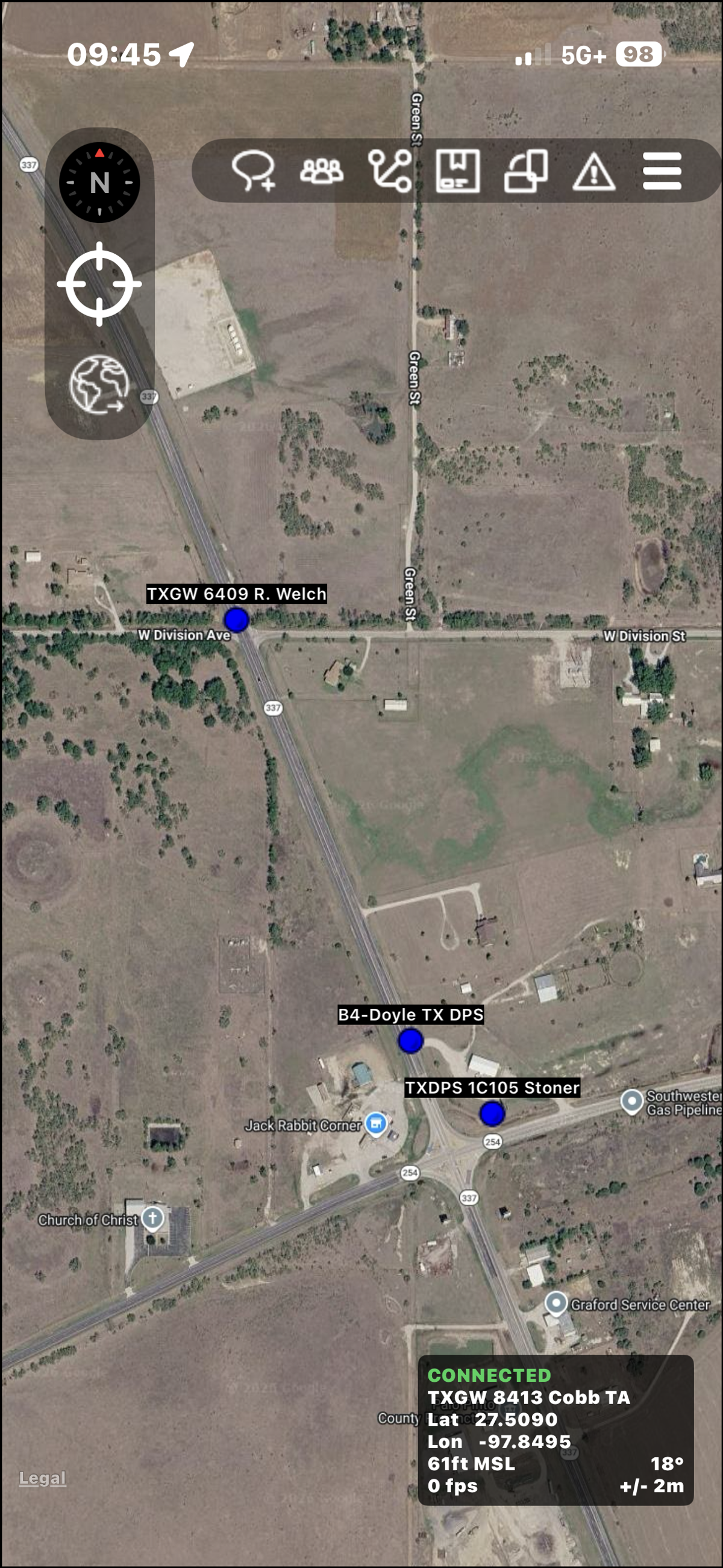
To someone outside the TAK community, automatically assigning the correct map color might sound like a cosmetic feature.
It isn’t.
Color is data.
During a large operation, commanders do not have time to open the profile associated with every icon on a crowded map.
Visual conventions allow the human brain to interpret information rapidly.
A glance at the common operating picture can help command understand the composition and distribution of resources across an incident.
If those visual conventions are inconsistent, that advantage deteriorates.
A responder who accidentally identifies as the wrong team or agency type is not simply displaying the wrong color.
They are introducing inaccurate information into the common operating picture.
TAK.gov describes personnel accountability, including knowing who is where during a crisis, as paramount to responders at all levels. It also notes the importance of a unified situational awareness environment for public safety.
The Bridge integration adds another layer:
Knowing who is where, and understanding what they represent, without relying on every individual to configure that information correctly.
The Advantage Becomes Greater as TAK Scales
This capability matters for a tactical team.
It matters much more for a state.
A specialized unit may have twenty experienced TAK users who train together regularly. They can establish conventions, configure devices, and correct inconsistencies relatively easily.
A statewide deployment is different.
Hundreds of agencies may participate.
Some responders may use TAK every day.
Others may use it primarily for major events or disaster response.
Some agencies have dedicated TAK administrators.
Small agencies may not.
Mutual aid can introduce personnel who have never worked together before.
The larger and more diverse the user community becomes, the less practical it is to depend on manual configuration for statewide consistency.
Automation allows the state’s standards to scale with the deployment.
Proven in the Field: Overcoming the Interoperability Barrier at the Ross Fire
Proven in the Field: Overcoming the Interoperability Barrier at the Ross Fire
When disaster strikes, coordinating a mix of state, local, and mutual-aid resources can become an administrative and operational bottleneck. During the Ross Fire in Palo Pinto County, Texas solved this challenge in real time. The incident served as the first natural disaster deployment of Bridge4PS's integrated Team Awareness Kit (TAK) location-sharing capability—proving that agencies can achieve a comprehensive common operating picture without complex training or heavy technical friction.
Historically, looping mutual-aid partners into the Texas Department of Public Safety (TxDPS) TAK environment required individual active software configurations. At the Ross Fire, Bridge4PS shattered that barrier. Responders who were not active TAK users simply turned on location sharing inside their secure Bridge4PS app. Instantly, they became fully visible on the TAK common operating picture.
For public safety administrators, the takeaway is clear: this complementary app suite maximizes statewide interoperability without demanding that every single responder master a complex technical platform. By leveraging the Texas Interoperability App Suite, command staff can rapidly expand situational awareness, protect personnel in the field, and orchestrate seamless multi-agency responses the moment it matters most.
Identity Can Improve More Than Color
The same principle extends beyond team colors.
When reliable identity metadata is available, it can also support standardized callsigns and role information.
Instead of allowing users to enter arbitrary naming conventions, verified information can help create a predictable structure such as:
[Agency] [Radio Callsign] [Last Name]
For example:
TXDPS 1A505 SMITH
Likewise, when appropriate role information is available, specialized functions such as Team Lead, Medic, Sniper, or Headquarters can be represented more consistently.
The broader concept is important.
Bridge is not simply connecting another application to TAK. It is bringing a verified public safety identity layer into the integration.
That makes the information reaching TAK richer and more operationally meaningful.
Texas Is Demonstrating the Integrated Model
Texas has already moved beyond viewing Bridge4PS and TAK as unrelated applications.
The Texas interoperability model pairs TAK’s geospatial capabilities with Bridge4PS’s secure, real-time collaboration and verified public safety network.
TAK provides the mapping and common operating picture.
Bridge provides the collaboration and identity environment connecting public safety professionals across agencies, disciplines, and jurisdictions.
The integration increasingly allows those capabilities to reinforce one another.
Verified identity can inform TAK configuration.
Bridge users can access the Texas TAK environment through integrated authentication pathways.
TAK users can collaborate through the broader Bridge public safety network.
New capabilities continue to reduce operational friction between the platforms.
For states considering how to expand TAK beyond individual teams or agencies, Texas offers an important example of what’s possible when TAK integrates with a platform designed from the start around verified public safety identity and interoperability.
Read more in our case study.
Integration Is More Powerful When the Systems Understand Each Other
The future of public safety interoperability is not simply connecting more applications.
It is making those connections smarter.
TAK already provides the architecture to integrate third-party technologies. Its API and plugin model were intentionally designed to support expanded mission capabilities.
The next question for states and agencies should be:
What does each integrated system actually contribute to the common operating picture?
Bridge4PS brings something particularly valuable to that equation.
Verified public safety identity.
Organizational metadata.
Role information.
A nationwide collaboration environment built specifically for public safety.
When that information is passed into TAK, the integration can do more than establish connectivity.
It can automatically translate identity into operational context.
For statewide deployments, that means less manual configuration, more consistent application of TAK SOPs, fewer opportunities for user error, and a clearer common operating picture during incidents when situational awareness matters most.
Because interoperability is not simply about getting every responder onto the same map.
It is about making sure everyone looking at that map understands what they are seeing.
For more information about TAK’s extensible architecture and its use for public safety situational awareness, visit the official U.S. Government TAK.gov resource. TAK.gov
Frequently Asked Questions
Ready to strengthen your team's communication security?
See how Bridge4PS can transform your emergency response coordination with secure, compliant messaging built for public safety.