
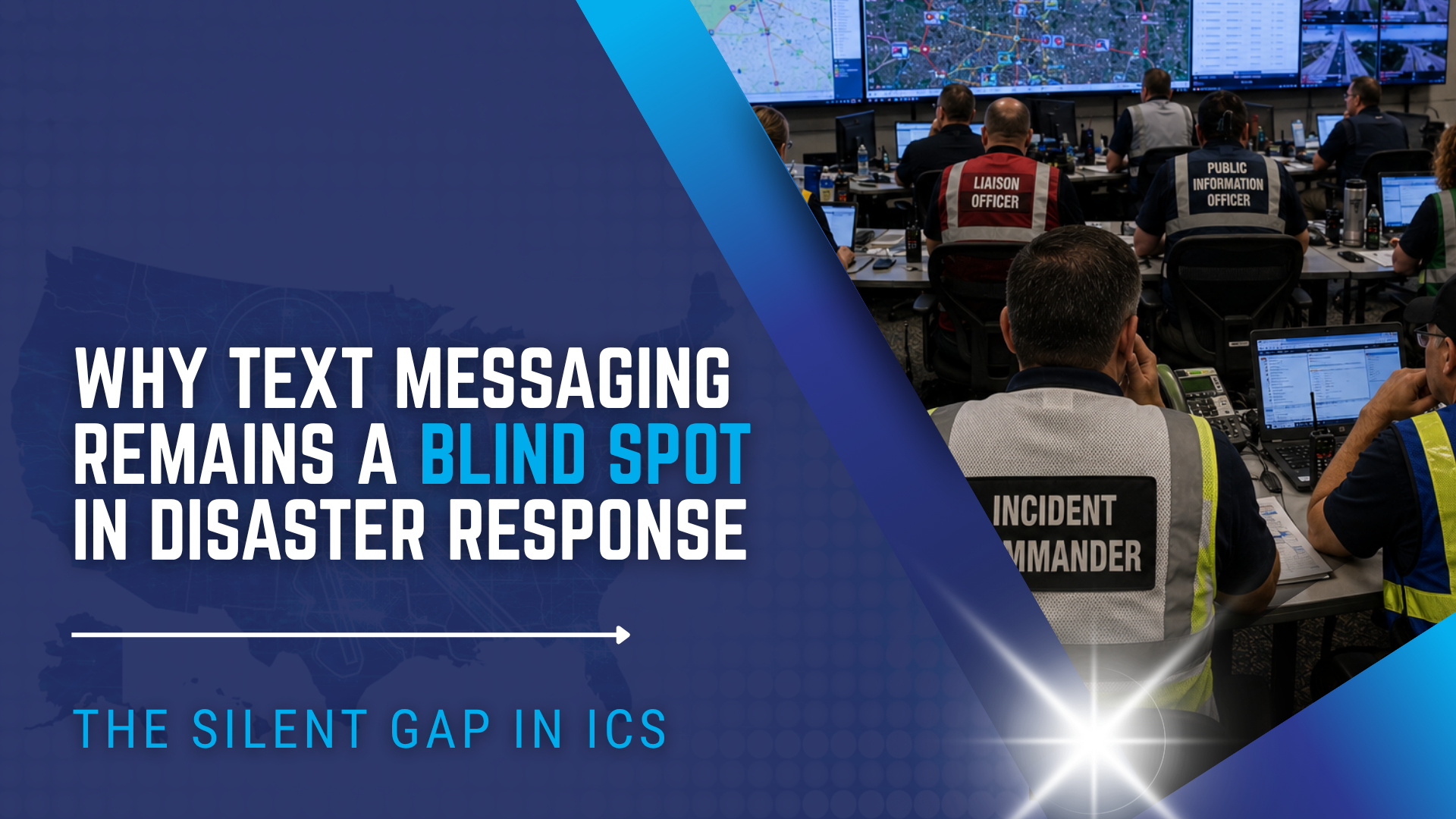
For decades, the Incident Command System (ICS) has served as the backbone of disaster response in the United States. It provides structure for command, logistics, operations, planning, communications, and resource management during emergencies ranging from hurricanes and wildfires to active assailant incidents and civil unrest.
But despite how comprehensive ICS has become, one of the most widely used tools in modern disaster communications still exists largely outside the framework:
Text messaging.
Across public safety, responders rely on text-based communication every day. Officers coordinate investigations through messaging apps. Emergency managers share updates through group texts. Multi-agency teams exchange photos, locations, and operational updates through mobile devices during rapidly evolving incidents.
In practice, text messaging has become a critical operational layer in public safety communications.
The problem is that ICS was never designed around it.
As a result, many agencies now operate with highly structured command systems layered on top of largely unstructured digital communications. This disconnect has become one of the least discussed contributors to modern communications failures during disaster response and multi-agency incidents.
Text Messaging Became Operational Before It Became Governed
Text messaging solved a practical problem for public safety long before formal policies or frameworks caught up.
It was:
- Fast
- Mobile
- Easy to use
- Quiet during tactical operations
- Capable of sharing photos and maps instantly
- Effective across jurisdictions and disciplines
Over time, texting evolved from convenience into operational dependency.
The challenge is that most consumer messaging platforms were never designed for public safety operations or ICS-aligned incident coordination. They rely heavily on personal contact lists, unmanaged groups, and informal communication practices.
That works until incidents become large, fast-moving, or multi-jurisdictional.
One emergency manager described it this way:
“ICS has structure for almost everything except the thing people use all day long to communicate.”
Another responder explained:
“We train constantly on radio procedures and command structure, but when incidents happen, everybody immediately starts texting in systems that have no operational governance.”
Why Consumer Texting Creates Operational Risk
Traditional texting and consumer messaging applications create several operational challenges during major incidents.
Common problems include:
- Responders not having the right phone numbers
- Retired or transferred personnel remaining in group texts
- Multiple disconnected text threads discussing the same incident
- Critical information buried in unrelated conversations
- No visibility into who received operational updates
- Difficulty onboarding new responders mid-incident
- Limited auditability and records retention
- Potential exposure of sensitive information
These issues become especially problematic during regional disasters or incidents involving multiple agencies.
When responders from neighboring jurisdictions, state agencies, or federal partners arrive at an incident, communication often depends on whether someone has the correct phone number saved on their device.
That is not interoperability. It is improvisation.
This is one reason communication challenges continue to appear prominently in After-Action Reports following major incidents nationwide.
In many cases, communications failures are not caused by a lack of technology, but by the absence of structured digital communication workflows. As disaster communications increasingly rely on text-based coordination, agencies are recognizing that unmanaged messaging environments create operational gaps that ICS was never originally designed to address and, in fact, weren’t even available when ICS was first developed.
ICS Has a Digital Messaging Gap
ICS transformed public safety by standardizing command structure and operational coordination. Radios became interoperable. Mutual aid became scalable. Resource management became structured.
Digital messaging, however, evolved independently.
While ICS and NIMS emphasize interoperability and information sharing, there are still very few formal operational standards around:
- Secure messaging governance
- Persistent operational channels
- Digital communication accountability
- Cross-jurisdiction collaboration workflows
- Identity verification and user management
- Operational continuity across shifts and operational periods
As a result, agencies are often left to create their own informal messaging practices during incidents.
The issue is not whether text messaging should be used in disaster response. It already does.
The issue is that public safety increasingly depends on a communication method that remains largely unstructured operationally and lacking governance.
FEMA’s National Incident Management System highlights the importance of interoperable communications and information sharing, but detailed operational guidance around secure digital messaging remains limited.
Public Safety Needs Better Text Alternatives
The answer is not eliminating digital messaging. Modern public safety operations depend on it.
The answer is replacing unmanaged communication environments with structured, secure systems specifically designed for operational coordination.
This is where public safety text alternatives become operationally important.
Unlike consumer texting applications, purpose-built public safety messaging platforms should provide:
- Verified user environments
- Persistent operational channels
- Structured incident coordination
- Nationwide interoperability
- Auditability and records retention
- Secure messaging aligned with operational governance
Most importantly, they should support communications workflows that mirror real operational structures rather than rely on improvised group texts.
One responder summarized the issue clearly:
“We already operationalized radios decades ago. Messaging is now just as operationally important, but most agencies still treat it informally.”
Daily Use Builds Operational Readiness
One of the biggest misconceptions about disaster communications is that coordination problems only emerge during catastrophic incidents.
In reality, communication habits are built every day.
If agencies rely on fragmented texting workflows during normal operations, those same workflows will carry into major incidents. Muscle memory will kick in, and personnel will default to the systems they already know and trust.
That is why daily operational use matters.
Secure messaging platforms designed for public safety allow agencies to build familiarity during:
- Shift briefings
- Event planning
- Task force coordination
- School safety collaboration
- Investigative operations
- Regional planning meetings
This creates operational muscle memory before a crisis occurs.
One public safety coordinator explained it this way:
“You cannot expect people to suddenly communicate differently during a disaster than they do every other day.”
Real-World Lessons From the Kerrville Flood Response
Communications Failures Are Often Governance Failures
The importance of structured messaging became particularly clear during the Kerrville flood response in Texas. Agencies from multiple jurisdictions needed to coordinate quickly, maintain situational awareness, and share updates across operational periods.
Rather than relying solely on fragmented text chains or disconnected communication methods, responders leveraged structured collaboration channels to support unified operations and real-time coordination.
The operational value was not simply faster communication. It was maintaining continuity, accountability, and shared situational awareness across agencies throughout the incident.
Read more about the Kerrville flood response.
Public safety agencies already recognize the importance of governance for radios, dispatch systems, and resource management. Messaging environments require the same level of operational structure.
Without governance:
- Communication becomes fragmented
- Situational awareness becomes inconsistent
- Information gets duplicated or lost
- Accountability decreases
- Coordination slows down
The problem is not that responders use text messaging.
The problem is that public safety still lacks standardized operational frameworks for how digital messaging should function during coordinated response.
The Future of ICS Includes Secure Messaging
The future of ICS and disaster communications will increasingly depend on secure digital collaboration environments.
As incidents become more complex and more multi-jurisdictional, public safety agencies need communication systems that support:
- Real-time interoperability
- Structured incident coordination
- Identity verification
- Persistent operational context
- Accountability and governance
Secure messaging is no longer supplemental communication.
It is operational infrastructure.
Until national frameworks evolve further, local and state agencies will continue to lead the way by developing SOPs, governance models, and operational structures around secure messaging platforms aligned with ICS principles.
The silent gap in ICS is no longer theoretical.
It exists every day during real-world operations.
FAQs
Q. What is federation in public safety technology?
Federation allows users to log in with one trusted credential and securely access multiple public safety systems through single sign-on, reducing the need for separate accounts.
Q. Why is text messaging considered a weakness in ICS?
ICS provides structure for radios and command coordination but offers limited operational guidance around digital messaging workflows, governance, and interoperability.
Q. Why do communications failures still happen during disasters?
Many communications failures occur because agencies rely on fragmented texting, disconnected apps, and informal coordination methods that are not operationalized within ICS structures.
Q. What are public safety text alternatives?
Public safety text alternatives are secure messaging platforms designed specifically for operational coordination, interoperability, and incident management.
Q. Why is secure messaging important for disaster communications?
Secure messaging supports structured information sharing, persistent operational context, and coordinated communication across agencies and operational periods.
Q. Why are consumer messaging apps problematic during incidents?
Consumer apps lack operational governance, identity verification, auditability, and structured coordination capabilities needed during public safety incidents.
Q. How does daily use improve disaster communications?
Daily use builds familiarity and operational muscle memory so responders already know how to coordinate effectively before a major incident occurs.
Q. What should agencies do to improve digital coordination?
Agencies should develop SOPs, governance models, and operational communication structures around secure messaging platforms rather than relying on unmanaged texting workflows.