Message Fatigue in Public Safety: Why Communication Noise Puts Operations at Risk
Every public safety professional has experienced it.
The phone vibrates constantly. Group texts multiply throughout the day. The same operational update arrives through text messages, consumer messagin
g apps, email, and radio. A routine update generates dozens of replies saying “Roger,” “Copy,” “10-4,” or a thumbs-up emoji. By the time a truly important message arrives, it is buried beneath a flood of notifications.
This is message fatigue.
While much attention has been given to alert fatigue in healthcare and emergency management, message fatigue has quietly become one of the most significant operational challenges facing public safety. It increases cognitive load, interrupts responders during critical tasks, and makes it more difficult to identify information that actually requires action.
The problem is not that agencies communicate too much.
The problem is that today’s communication methods often create unnecessary communication noise that distracts from the mission.
Message fatigue is rarely caused by a single issue. More often, it results from communication friction created by fragmented text groups, disconnected messaging applications, duplicate conversations, and notification overload.
Fortunately, many of the causes of message fatigue are operational challenges that can be addressed through purpose-built public safety collaboration tools, standardized communication practices, and thoughtful operational planning.

Fragmented Group Texts Create Communication Chaos
One of the biggest contributors to message fatigue is the lack of a common enterprise messaging platform.
Without one, responders naturally communicate with the people they already know.
One supervisor creates a text group using the contacts already stored in their phone. Another starts a different group with a slightly different combination of people. As additional agencies become involved, more text groups are created to include responders who were excluded from earlier conversations.
Soon, multiple overlapping text groups are discussing the same incident.
The same updates are copied between conversations. Personnel receive duplicate notifications from different groups discussing the same event. Responders must monitor several communication streams simply to maintain situational awareness.
This fragmentation does more than create inconvenience.
It increases the likelihood that critical information will be delayed, overlooked, or missed entirely.
Too Many Apps, Too Many Communication Streams
The challenge becomes even greater when agencies rely on multiple consumer messaging applications.
One agency communicates through text messaging.
Another prefers Signal.
A regional task force uses WhatsApp.
Others continue relying on email.
Responders quickly find themselves switching between applications simply to determine where the latest operational update has been posted.
Each application maintains its own conversations, notifications, contacts, and history.
Instead of reducing communication friction, multiple disconnected applications require responders to spend more time managing communication tools than managing the incident itself.
A common public safety collaboration platform replaces these disconnected communication streams with a single operational environment where authorized users can coordinate from a single trusted platform, rather than juggling multiple applications.
Radio Discipline Doesn’t Always Translate to Messaging
Public safety professionals are trained to acknowledge critical radio traffic.
“10-4.”
“Copy.”
“Received.”
Those acknowledgments serve an important purpose on the radio by confirming that a message was heard and understood.
Messaging platforms work differently.
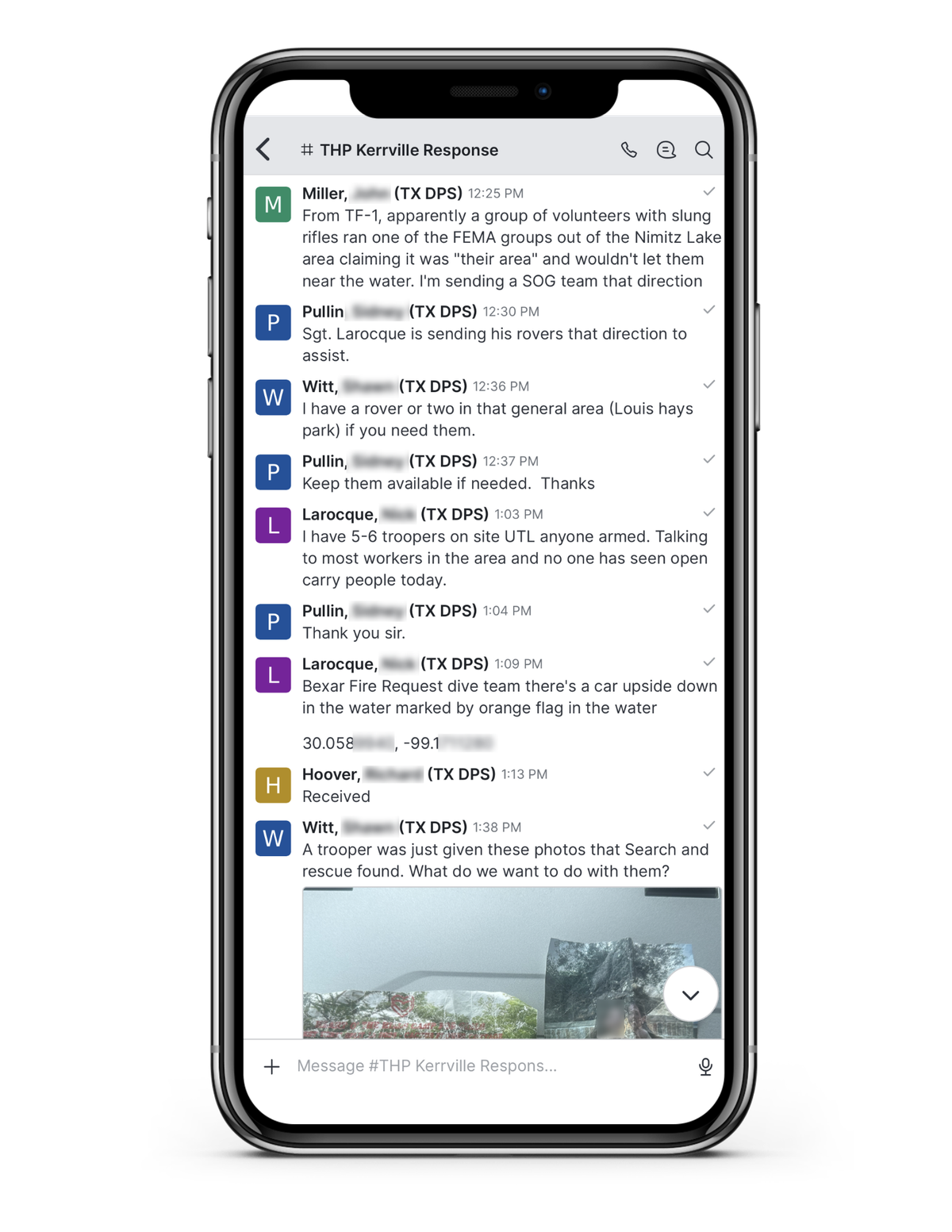
Every acknowledgment often generates another notification for everyone participating in the conversation. A single operational update sent to dozens of responders can quickly produce an equal number of acknowledgment messages, each creating additional notifications without adding new operational information.
Over the course of a large incident, these well-intentioned acknowledgments can create hundreds of interruptions, making it harder for responders to identify updates that actually require action.
The solution is not to eliminate accountability.
It is to use collaboration tools that preserve accountability without creating unnecessary communication noise.
A Better Way to Acknowledge Messages
Supervisors need confidence that personnel received critical information. The challenge is preserving that accountability without creating unnecessary notifications for everyone else.
Purpose-built public safety collaboration platforms address this differently than consumer messaging applications. Comprehensive read receipts allow authorized users to see who has viewed a message, often eliminating the need for responders to reply with “Roger,” “Copy,” or “Received” simply to confirm they saw it. When an acknowledgment is appropriate, reactions can provide that confirmation without generating another notification for everyone else in the conversation.
The result is greater accountability with far less communication noise. Supervisors have better visibility into message delivery, responders avoid unnecessary interruptions, and important operational updates remain easier to identify.
This seemingly small design decision becomes increasingly valuable during large-scale incidents where reducing communication noise helps ensure critical information stands out.
Public-Safety Exclusive Collaboration Features Reduce Communication Noise
Purpose-built public-safety-exclusive collaboration platforms also include features that reduce ambiguity before it generates additional messages.
During a fast-moving incident, a message asking “John” to establish a perimeter or directing responders to “continue this discussion in the School Safety channel” can quickly lead to clarification messages if it isn’t clear which John or which channel is being referenced.
Those clarification messages may seem minor, but across hundreds of users and dozens of operational conversations, they create additional communication noise that competes with mission-critical information.
Enterprise collaboration features such as user mentions and channel links eliminate much of that ambiguity by allowing responders to tag specific people and link directly to operational channels. Tagged users receive a clear visual indication that the message is directed to them, while mentions are collected in a dedicated Mentions view for easy reference.
As collaboration environments grow to hundreds or even thousands of users across multiple agencies, these capabilities improve precision, reduce unnecessary clarification messages, and keep conversations focused on the mission.
Managing Notifications Instead of Being Managed by Them
Not every message deserves the same level of attention.
Public safety operations require flexibility.
Some updates require immediate action.
Others can wait until personnel have a free moment.
Purpose-built public safety collaboration platforms allow users to manage notifications based on operational priorities rather than treating every message the same.
Features such as custom notification sounds allow responders to immediately distinguish routine operational activity from higher-priority communications without constantly checking their devices.
Off-Duty Mode helps responders disconnect from routine operational activity while remaining available for critical incidents. Instead of being interrupted by day-to-day shift communications, users can prioritize emergency notifications that require immediate attention.
These capabilities help reduce communication fatigue while preserving operational readiness.
The goal is not simply better communication.
It is improving operational outcomes by reducing communication friction, eliminating unnecessary noise, and ensuring critical information stands out when every second counts.
“If you're an agency looking to level up your communication, look no further than Bridge 4 Public Safety! Radios, CAD, phones, etc. all have their limitations. B4PS brings endless capabilities when it comes time to communicate internally and across numerous jurisdictions, especially during major incidents.”
Daily Operations Build Better Communication Habits
Message fatigue is not just a technology problem.
It is also an operational discipline.
Organizations that establish communication standards experience less communication noise during both routine operations and major incidents.
Examples include:
- ✓Using dedicated operational channels instead of creating new text groups.
- ✓Posting information once rather than duplicating it across multiple conversations.
- ✓Reserving replies for information that advances the operation.
- ✓Using acknowledgments that confirm receipt without generating unnecessary notifications.
- ✓Separating operational updates from general conversation.
- ✓Leveraging collaboration features that reduce ambiguity instead of generating follow-up questions.
- ✓Using one public-safety-exclusive collaboration platform instead of switching between multiple messaging applications.
These practices improve operational efficiency every day while building habits that become even more valuable during complex incidents, disasters, investigations, and special events.
Built Specifically for Public Safety Operations
Bridge4PS was originally funded by the U.S. Department of Homeland Security to create a secure, interoperable collaboration environment for verified public safety professionals nationwide.
From the beginning, the objective was not simply to replace text messaging.
It was to reduce communication friction while enabling secure, interoperable collaboration across agencies, disciplines, and jurisdictions.
The platform was designed around the operational realities of emergency response, criminal investigations, planned events, and day-to-day public safety coordination.
Rather than adapting consumer messaging applications for public safety, Bridge4PS provides capabilities specifically designed to improve operational coordination and reduce communication noise.
These include:
- ✓Secure, compliant messaging.
- ✓A verified nationwide public safety network that reduces reliance on fragmented text groups and consumer messaging applications.
- ✓Persistent operational channels that replace fragmented text groups.
- ✓Message acknowledgments that reduce unnecessary notifications while preserving accountability.
- ✓User mentions and channel links that eliminate ambiguity and reduce unnecessary clarification messages.
- ✓Custom notification sounds that help responders prioritize operationally significant communications.
- ✓Off-Duty Mode that filters routine operational activity while keeping responders available for critical incidents.
Together, these capabilities help agencies spend less time managing communications and more time accomplishing the mission.
Better Communication Begins with Less Noise
Message fatigue is rarely caused by a single communication tool. It is usually the cumulative result of fragmented text groups, multiple messaging applications, unnecessary acknowledgment messages, ambiguous conversations, and notification overload.
Notifications were originally designed to help people focus on information that required their attention. As WIRED notes in its history of notifications, the growing number of applications, conversations, and competing alerts has often had the opposite effect, making it harder to distinguish routine activity from information requiring immediate action.
For public safety professionals, every unnecessary interruption competes for attention that may be needed to make a critical operational decision.
Purpose-built public safety collaboration platforms help reverse that trend by replacing fragmented communication with structured collaboration, reducing unnecessary notifications, and giving responders greater control over how information is delivered.
In public safety, attention is one of the most valuable operational resources responders have. Reducing communication noise is not about sending fewer important messages. It is about ensuring the right information reaches the right people at the right time so they can make better decisions, coordinate more effectively, and ultimately achieve better outcomes for the communities they serve.
To learn more about why traditional text messaging falls short during complex public safety operations, read our companion article:
Frequently Asked Questions
Ready to strengthen your team's communication security?
See how Bridge4PS can transform your emergency response coordination with secure, compliant messaging built for public safety.