When Systems Fail: Why PACE Planning Must Prioritize Communications Redundancy and Interoperability
The Best Time to Establish Redundant Communications Is Before You Need Them
The technology disruptions experienced throughout November 2026 serve as a reminder of how quickly organizations can lose access to the systems they depend on every day. Within a relatively short period, outages affected enterprise communications, aviation, banking, cloud infrastructure, national security, municipal government, healthcare, and other critical services.
Some resulted from software defects, others from network instability or routine maintenance, and still others from cybersecurity incidents. Regardless of the cause, organizations faced the same fundamental challenge: how to maintain operations when their normal systems became unavailable.
For public safety agencies, that challenge extends far beyond restoring technology. Personnel must continue responding to emergencies, coordinating resources, sharing intelligence, and working with operational partners while technology teams investigate and resolve the underlying problem.
This is precisely why communications redundancy and PACE planning must be fundamental components of public safety preparedness.
Different Causes, Similar Operational Consequences
The disruptions reported over the past two weeks demonstrate the variety of circumstances that can compromise technology availability:
- Software defects: Microsoft confirmed that a technical defect contributed to its widespread Microsoft 365 outage, while JPMorgan Chase attributed banking disruptions to a software issue.
- Network instability: The Federal Aviation Administration experienced telecommunications network problems that disrupted aviation operations nationwide.
- Maintenance and software updates: The National Security Agency and Apple experienced service disruptions associated with scheduled maintenance or internal technology changes.
- Disaster recovery testing: Workday experienced service interruptions associated with its disaster recovery testing.
- Cyberattacks and suspected security breaches: The FBI began investigating an apparent breach of its National Crime Information Center (NCIC), a critical resource used by law enforcement agencies nationwide. The U.S. Department of Agriculture experienced a cyberattack targeting its payment systems; South Portland, Maine, shut down its municipal network following the discovery of a cybersecurity issue, and Monadnock Community Hospital attributed a server outage to a cyber incident.
Although federal officials reported on November 18 that they had found no evidence linking the earlier technology outages to a coordinated cyberattack, subsequent reports of suspected breaches involving federal agencies underscore the importance of preparedness for both malicious and nonmalicious disruptions. Organizations must be prepared to maintain secure communications not only when their systems become unavailable, but also when the integrity or security of those systems is called into question.
What they collectively demonstrate is that even sophisticated organizations with substantial technology investments remain vulnerable to disruption. Public safety agencies cannot afford to build communications continuity plans around assumptions about which systems will remain available or what might cause them to fail.
What Is PACE Planning?
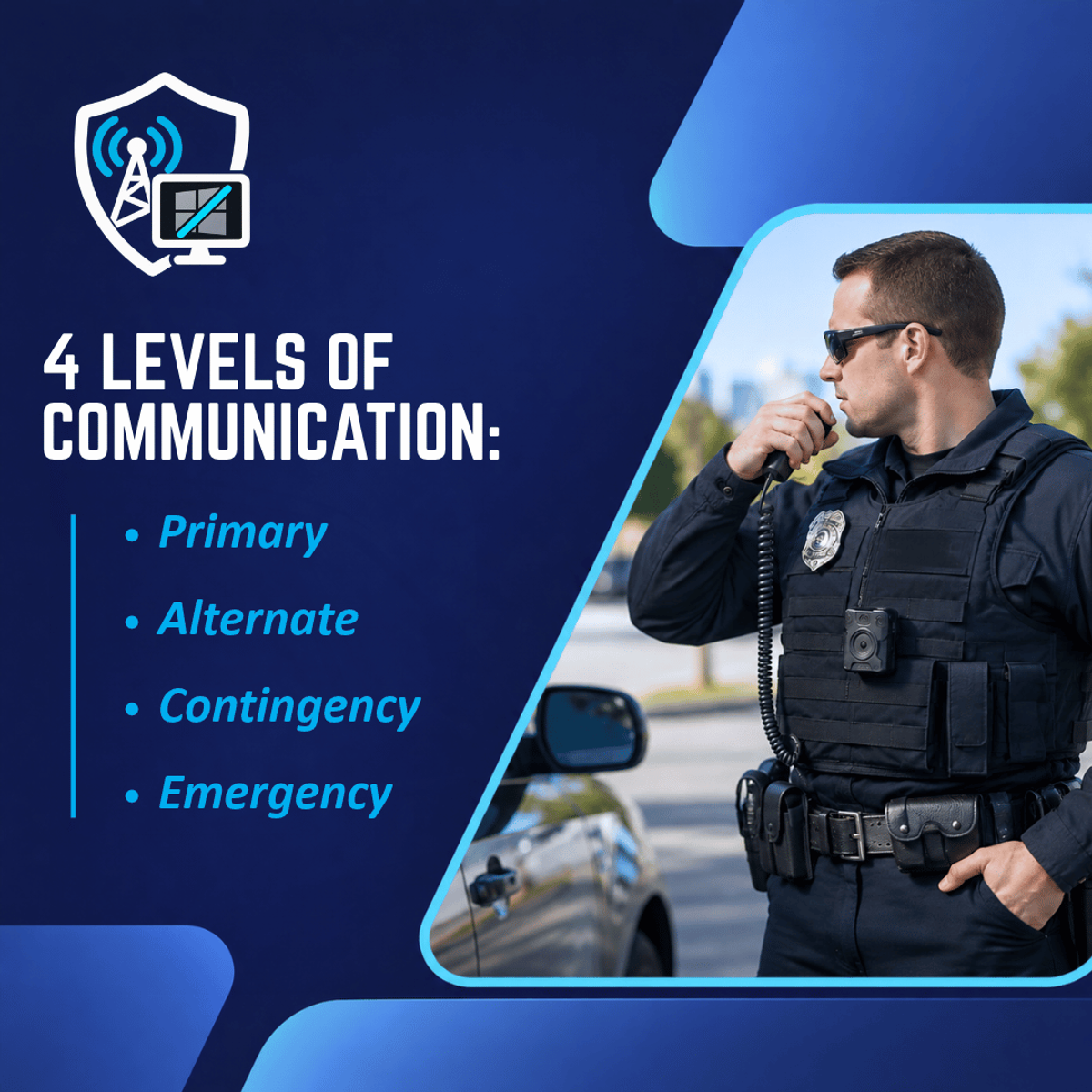
PACE stands for Primary, Alternate, Contingency, and Emergency. It is a communications planning methodology that establishes multiple methods of communication so personnel can continue operating as individual capabilities become unavailable.
The four levels generally consist of:
- Primary: The preferred communications method used during normal operations.
- Alternate: An established alternative when the primary method becomes unavailable or unreliable.
- Contingency: An additional communications capability when both primary and alternate methods fail.
- Emergency: A final communications option when other capabilities are unavailable.
The Cybersecurity and Infrastructure Security Agency (CISA) provides guidance on leveraging PACE planning within the emergency communications ecosystem, emphasizing redundancy, interoperability, continuity, training, and predetermined triggers for transitioning between communications methods.
Effective PACE planning requires more than identifying four different technologies. Agencies must understand the dependencies behind each technology and whether a single failure could compromise multiple communications methods simultaneously.
Redundancy Requires Independence
Having several ways to communicate does not necessarily mean an organization has redundant communications.
An agency may use email, enterprise messaging, shared documents, and internal collaboration tools, yet all may depend on the same enterprise environment, authentication service, or network infrastructure.
Similarly, an agency may designate SMS text messaging as its backup communications method without considering what happens when personnel experience a cellular carrier outage.
True communications redundancy requires alternatives that do not share all the same points of failure.
A redundant digital communications platform should operate outside the agency's enterprise network and systems, function across cellular carriers, and remain accessible through alternative internet connections, including Wi-Fi and satellite-enabled internet services where available.
Agencies must also evaluate authentication dependencies. If a redundant platform relies exclusively on an enterprise identity provider that becomes unavailable during an incident, personnel may still encounter access problems. These dependencies should be identified and addressed through established, tested access procedures.
The objective is to maintain as many independent communications pathways as possible without introducing unnecessary security risks or operational complexity.
Redundancy Should Not Come at the Expense of Security or Compliance
When enterprise systems fail, personnel frequently resort to whatever communications tools remain available. Personal texting, consumer messaging applications, and informal group chats quickly become substitutes for established organizational systems.
While understandable, this approach can introduce significant risks precisely when sensitive information may be circulating.
Personnel may exchange personal phone numbers, share operational information through unauthorized applications, create conversations outside established retention policies, or inadvertently expose sensitive information to unintended recipients.
During a cybersecurity incident, these risks become particularly concerning. Discussions may involve compromised systems, suspected vulnerabilities, investigative information, containment strategies, or sensitive details about organizational infrastructure.
Agencies should not have to choose between maintaining communications and protecting information.
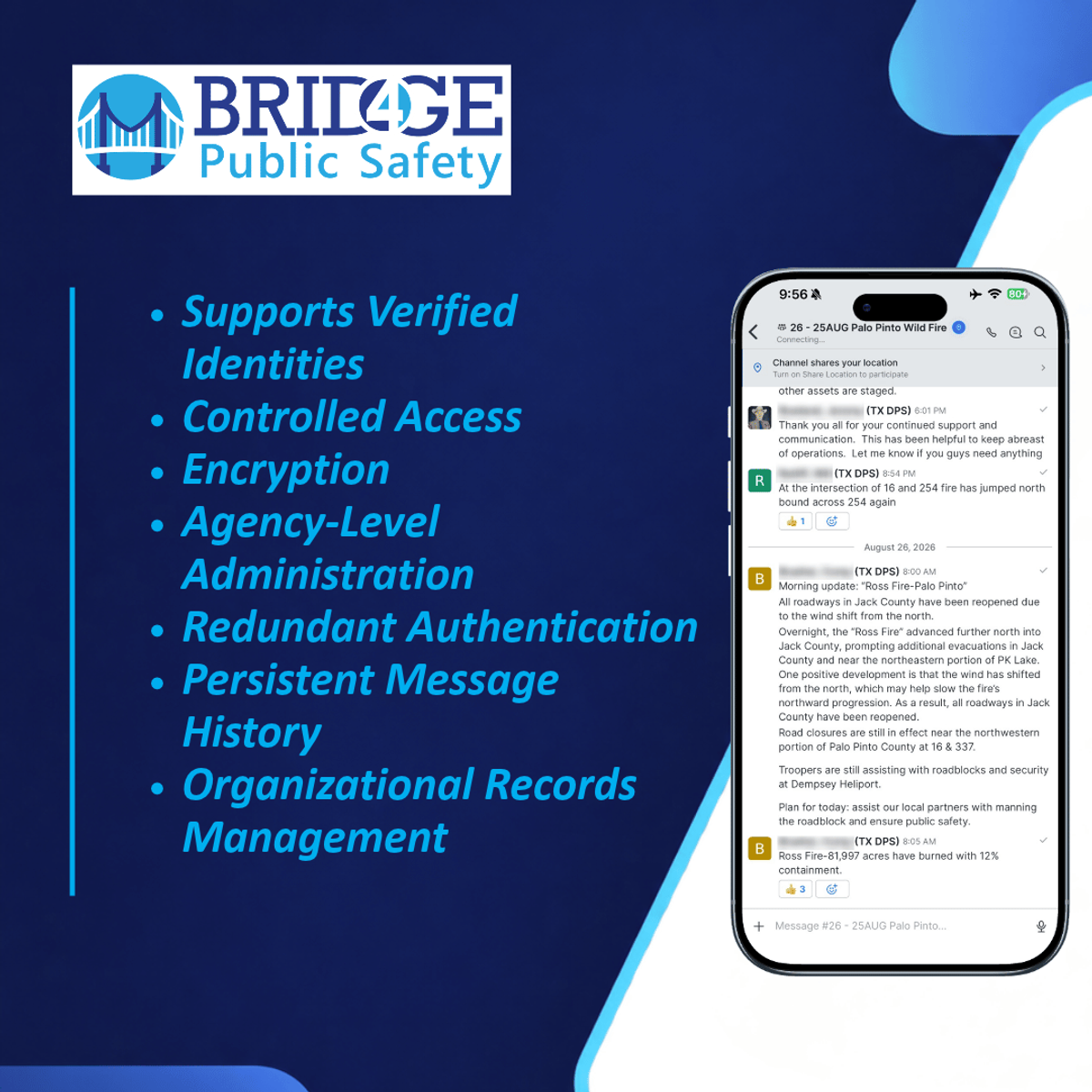
A well-designed PACE plan should include a secure digital collaboration platform that supports verified identities, controlled access, encryption, agency-level administration, redundant authentication, persistent message history, and organizational records management, while allowing personnel to communicate across organizational boundaries without exchanging personal contact information.
Communications continuity should extend existing security and compliance practices, not undermine them.
Interoperability Must Be Part of Communications Redundancy
One of the most overlooked aspects of PACE planning is what happens outside an individual organization's boundaries.
An agency may establish an effective backup communications capability for its own personnel, but what happens when neighboring agencies, emergency management partners, communications centers, and supporting organizations transition to different systems?
Each organization may successfully maintain internal communications while collectively losing the ability to coordinate.
Public safety incidents rarely remain within one organization. Law enforcement, fire, EMS, emergency management, communications, IT, and other supporting disciplines frequently depend on information from one another to make operational decisions.
When each organization activates a different redundant communications tool, information becomes fragmented. Personnel must relay updates between platforms, recreate conversations, establish new contact lists, and determine which information is current.
A common redundant collaboration platform allows authorized operational partners to maintain communications across organizational boundaries, even when their respective enterprise systems are unavailable.
This is why regional and statewide PACE planning should incorporate shared digital communications capabilities alongside traditional voice interoperability.
As discussed in Beyond Chat: Why Public Safety Needs Collaboration, Not Just Messaging, the ability to exchange messages is only one component of effective operational coordination. Agencies also need a shared environment in which they can maintain situational awareness, preserve context, and coordinate activities throughout an incident.
Cyber Incidents Make Ground Truth Especially Important
During a cybersecurity incident, uncertainty can be as disruptive to operational decision-making as the technology failure itself.
When multiple organizations experience outages within a short period, questions naturally arise. Are the incidents connected? Is a particular service provider experiencing technical problems? Has an organization been compromised? Are other agencies experiencing similar symptoms?
Without a trusted mechanism for sharing information in real time, personnel may rely on speculation, social media reports, incomplete news coverage, or unverified information circulating through informal messaging groups.
A shared collaboration environment outside potentially compromised enterprise systems provides an opportunity to establish ground truth by enabling authorized personnel to communicate directly across organizations.
IT and cybersecurity personnel can exchange verified observations. Communications personnel can report service degradation. Emergency management officials can assess regional impacts. Law enforcement and other responders can communicate operational consequences as they occur.
This provides opportunities to identify emerging patterns, corroborate information, distinguish isolated failures from broader disruptions, and coordinate protective measures.
A shared platform does not replace technical threat analysis, formal incident reporting, or established cybersecurity protocols. It complements those capabilities by connecting the people who possess different pieces of the operational picture.
The faster organizations can collectively establish what is actually happening, the better positioned they are to make informed decisions.
Preserve the Conversation, Not Just the Ability to Communicate
Communications redundancy should also preserve operational context.
An incident may last several hours, days, or weeks. Personnel rotate through shifts, additional agencies become involved, and decisions evolve as new information becomes available.
Traditional group texting and many consumer messaging applications provide limited access to historical conversations for newly added participants. Information may also remain fragmented across individual devices, making it difficult to reconstruct decisions or retrieve important records.
A persistent, cloud-based collaboration environment maintains the conversation independently of individual devices.
Authorized personnel joining an incident can review retained messages, shared files, operational updates, and previous decisions. Personnel who replace devices can regain access to their conversations without transferring information from an old phone.
Once normal enterprise systems are restored, agencies retain an operational history that can support after-action reviews, investigative processes, records requests, and improvements to continuity planning.
Effective redundancy should preserve both communications availability and the information exchanged during the disruption.
Bridge4PS: An Independent, Nationwide Public Safety Collaboration Network
Originally funded by the U.S. Department of Homeland Security Science and Technology Directorate, Bridge4PS was created to solve one of public safety's most persistent challenges: enabling secure, interoperable collaboration across agencies, disciplines, and jurisdictions without relying on consumer messaging applications or agency-specific communications systems.
That experience has shaped a platform uniquely positioned to support public safety PACE planning.
Bridge4PS operates as a nationwide public safety collaboration network hosted independently of participating agencies' enterprise environments in AWS GovCloud. It is not an SMS messaging service and does not depend on any particular cellular carrier.
The platform combines several capabilities that are particularly valuable for communications redundancy.
Originally funded by the U.S. Department of Homeland Security Science and Technology Directorate, Bridge4PS was created to solve one of public safety's most persistent challenges: enabling secure, interoperable collaboration across agencies, disciplines, and jurisdictions without relying on consumer messaging applications or agency-specific communications systems.
That experience has shaped a platform uniquely positioned to support public safety PACE planning.
Bridge4PS operates as a nationwide public safety collaboration network hosted independently of participating agencies' enterprise environments in AWS GovCloud. It is not an SMS messaging service and does not depend on any particular cellular carrier.
The platform combines several capabilities that are particularly valuable for communications redundancy:
- Independent, cloud-hosted collaboration infrastructure.
- Access across supported mobile devices, computers, and different internet service providers.
- A nationwide directory of verified public safety professionals.
- Searchable interoperability and operational channels.
- Secure communications without exchanging email addresses or phone numbers.
- Persistent conversation history and authorized message exports.
- Controlled access and centralized security capabilities.
- Real-time collaboration across agencies, disciplines, and jurisdictions.
Unlike an isolated backup messaging application, Bridge4PS connects public safety professionals through an established nationwide network used for routine operations, investigations, natural disasters, planned events, and multi-agency coordination.
Years of supporting real-world public safety operations have reinforced an important lesson: the value of a communications platform is not simply its availability during an emergency, but the operational relationships and capabilities already established within it.
The Most Effective Backup Communications Tools Are Already in Use
A communications platform that personnel only encounter during an emergency presents its own operational risks.
Users may not remember their credentials, know how to find operational partners, understand notification settings, or recognize which channels they should monitor.
During a major technology outage or cybersecurity incident, agencies should not be attempting to distribute applications, establish accounts, verify identities, or train personnel for the first time.
Using Bridge4PS during daily operations helps agencies build familiarity, establish operational relationships, and develop communications practices that carry over naturally when other systems become unavailable.
Agencies can establish designated incident coordination channels, regional interoperability communities, cybersecurity coordination channels, and leadership communications environments before they are needed.
Regular exercises should also test transitions between communications methods, including scenarios involving unavailable enterprise authentication services, cellular carrier disruptions, and restricted access to government networks.
A cloud-based collaboration platform still requires internet connectivity, making network redundancy an equally important component of PACE planning. Agencies should establish alternative connectivity options across multiple cellular carriers, independent Wi-Fi networks, and satellite internet services to maintain access when their primary network becomes unavailable.
Plan for Redundancy Across the Entire Public Safety Ecosystem
Recent technology disruptions should prompt public safety leaders to evaluate not only their own communications continuity plans but also how those plans align with their operational partners.
Does the redundant communications platform operate independently of the agency's enterprise systems? Can personnel access it through alternative networks? Does it preserve operational history and protect sensitive information? Are neighboring agencies and supporting disciplines accessible through the same environment?
Most importantly, can everyone continue coordinating when their normal communications systems become unavailable?
Public safety communications resilience requires more than multiple ways to send a message. It requires independent communications pathways, trusted operational relationships, and the ability to maintain a shared understanding of events despite disruptions.
By incorporating an established, secure, interoperable collaboration network such as Bridge4PS into PACE planning, agencies can strengthen communications redundancy without sacrificing security, compliance, operational context, or interagency coordination.
The goal of PACE planning should not simply be to keep individual agencies communicating. It should be to keep the entire public safety ecosystem connected and operational.
Frequently Asked Questions
Ready to strengthen your team's communication security?
See how Bridge4PS can transform your emergency response coordination with secure, compliant messaging built for public safety.