Beyond Chat: Why Public Safety Needs Collaboration, Not Just Messaging
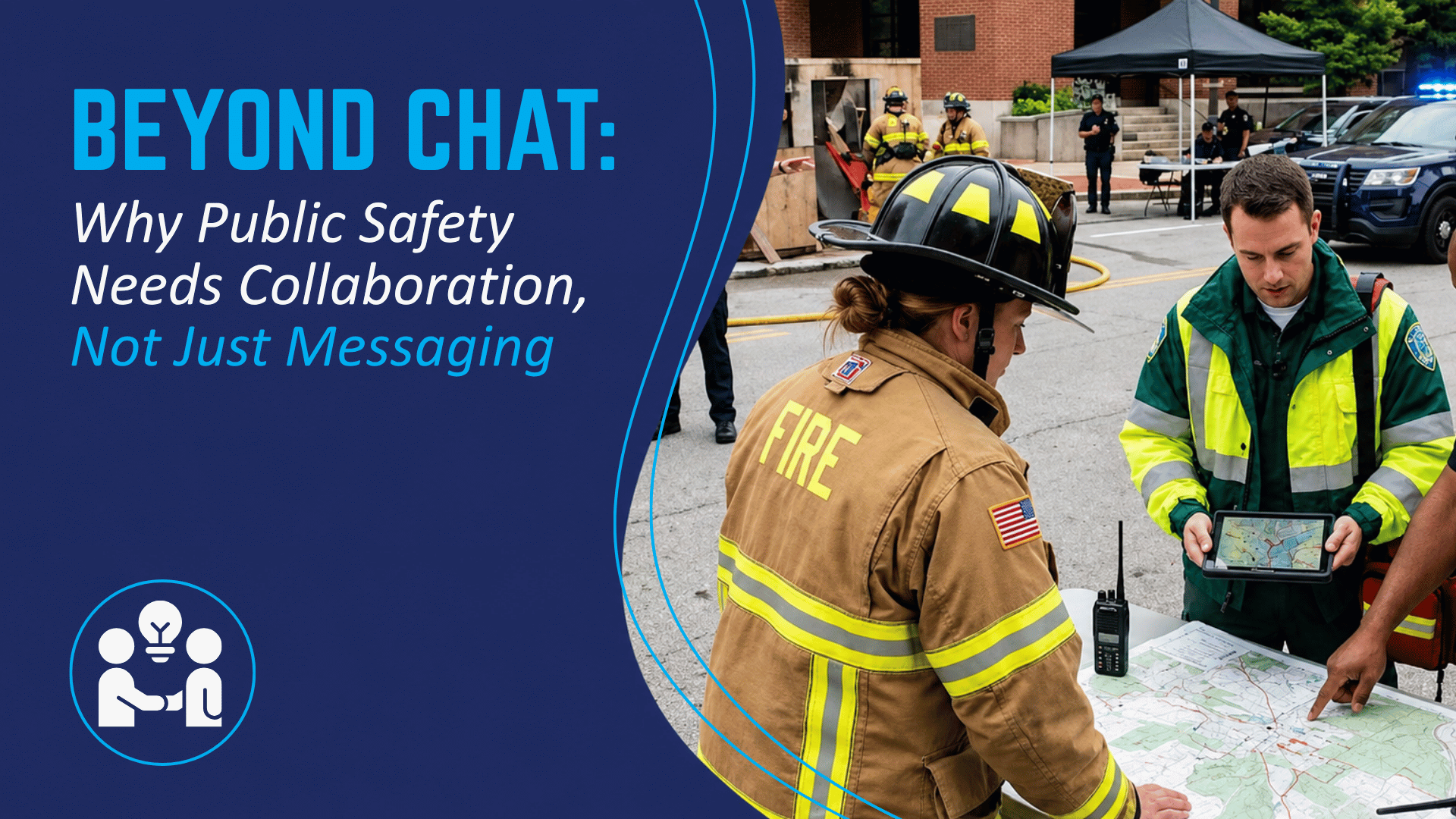
In public safety, communication has always been critical. Whether coordinating a major disaster, managing a large-scale special event, conducting a criminal investigation, or responding to an active assailant incident, the ability to exchange information quickly can directly impact outcomes, and public safety needs collaboration.
As a result, many agencies have adopted some form of digital messaging. Group texts, consumer messaging apps, internal chat tools, and public safety messaging platforms have become commonplace. Yet many organizations eventually discover that messaging alone is not enough.
The difference between a messaging platform and a collaboration platform may seem subtle at first. In practice, however, it can mean the difference between simply exchanging messages and achieving effective incident coordination.
As public safety operations become increasingly complex, agencies need more than a public safety chat tool. They need a collaborative operational environment designed to support real-world decision-making, multi-agency coordination, and sustained operations.
Messaging Solves Communication. Collaboration Solves Coordination.
At its core, messaging is designed to move information from one person to another.
A text message, chat thread, or direct message allows users to communicate quickly. For simple conversations, that may be sufficient.
However, public safety incidents are rarely simple.
A major operation may involve:
Multiple agencies
Multiple disciplines
Multiple operational periods
Changing personnel
Shared documents and intelligence
Resource requests
Situational updates
Command decisions
In these environments, communication alone is not enough.
The challenge is not simply sending information. The challenge is ensuring the right people have access to the right information at the right time while maintaining context throughout the life of an operation.
That is where collaboration becomes essential.
The Limitations of Basic Messaging Tools
Many messaging tools perform well within a single team or organization.
The problems begin when incidents expand beyond those boundaries.
Common limitations include:
Contact-Based Communication
Many messaging systems depend on phone numbers, email addresses, or manually maintained contact lists.
When incidents occur, responders often spend valuable time:
Looking for contact information
Building distribution lists
Creating group chats
Inviting outside stakeholders
These activities create friction at precisely the moment rapid coordination is needed.
Limited Operational Context
Most messaging tools are designed around conversations, not operations.
As incidents evolve, information often becomes fragmented across multiple text groups, direct messages, emails, and communication platforms. Responders may need to monitor several separate conversations just to maintain situational awareness, while personnel rotating into an operation often spend valuable time piecing together information from multiple communication streams.
A collaborative operational environment helps preserve continuity by keeping incident communications in a single, persistent channel. Personnel can be added when their role requires involvement, review previous messages to get up to speed, and leave channels when their responsibilities change. This reduces the need for duplicate conversations, minimizes information silos, and helps ensure everyone is working from the same information throughout the life of an operation.
This is particularly valuable during multi-day incidents, investigations, disasters, and special events where personnel rotate through shifts and responsibilities frequently. Rather than recreating information across multiple text groups, agencies can maintain a shared operational history that remains accessible to authorized participants as the incident evolves.
Organizational Silos
Many collaboration tools were originally designed for internal business communication.
They work well within a department but often require administrative involvement when coordination extends beyond organizational boundaries.
Adding external partners may require:
Account creation
Administrative approval
User invitations
Separate organizational environments
These barriers can significantly slow multi-agency coordination.
Collaboration Beyond Organizational Boundaries
Many messaging and collaboration tools work well inside a single agency. Public safety incidents rarely stay inside a single agency.
As operations grow, information often becomes fragmented across multiple organizations, communication platforms, and stakeholder groups. Responders may copy information between systems, forward updates to external partners, or maintain separate communication streams for different agencies involved in the same incident.
A true public safety collaboration environment allows authorized stakeholders to work from a common operational space. Instead of duplicating information across organizational boundaries and communication platforms, agencies can coordinate from a shared source of truth focused on the incident itself.
What Collaboration Looks Like in Public Safety
Collaboration platforms are built around operations, not conversations.
Instead of focusing solely on messaging, they provide a shared environment where agencies can coordinate activities, maintain situational awareness, and preserve operational context.
Effective public safety collaboration includes:
Persistent Operational Channels
Operations often require dedicated spaces aligned with missions, incidents, investigations, or events.
These channels maintain continuity before, during, and after an operation.
Personnel joining later can quickly understand:
Current status
Historical decisions
Operational objectives
Supporting information
Shared Situational Awareness
Collaboration platforms provide a common operating environment where participants can see updates as they occur.
Instead of information being trapped inside individual conversations, operational information becomes accessible to authorized stakeholders.
This improves decision-making and reduces duplication of effort.
Cross-Jurisdictional Coordination
Modern public safety operations rarely occur within a single agency.
Effective collaboration enables the following to coordinate within a shared operational environment.:
Law enforcement
Fire
EMS
Emergency management
Communications
IT
Government administrators
School district administrators
Other supporting disciplines
Structured Information Flow
Collaboration is not just communication.
It is communication organized around operational objectives.
This structure reduces confusion, improves accountability, and supports more effective incident coordination.
Why Public Safety Requires More Than Enterprise Chat
Many organizations attempt to adapt business collaboration tools to public safety environments.
While these tools often offer stronger messaging and collaboration capabilities than consumer-grade alternatives, they are typically designed around organizational boundaries and corporate workflows rather than emergency response. Public safety operations routinely involve personnel from multiple agencies, disciplines, and jurisdictions who must quickly establish trusted communications and coordinate activities around a shared mission.
Public safety presents unique challenges:
- Personnel regularly change assignments, roles, and agencies
- Operations cross jurisdictional and organizational boundaries
- Information must move quickly to support operational decisions
- Accountability and auditability are critical
- Sensitive information must be protected
- Response organizations must coordinate despite different governance structures
- Agencies need to collaborate without relying on administrators to create accounts, exchange user lists, or manage access for every external partner
A public safety collaboration platform must account for these realities.
That requires more than secure messaging.
It requires purpose-built infrastructure designed around how public safety professionals actually work, enabling trusted collaboration across agencies while reducing the administrative friction that often slows coordination when every minute matters.
The Evolution from Messaging to Operational Collaboration
For decades, public safety focused heavily on voice interoperability.
States invested in radio systems. Agencies developed mutual aid agreements. Communications centers established shared protocols.
Digital communications are now undergoing a similar evolution.
The question is no longer whether agencies should communicate digitally.
The question is whether they are using digital tools that support operational coordination.
As incidents become more complex, agencies are increasingly recognizing that messaging alone does not provide:
Situational awareness
Operational continuity
Interoperability
Accountability
Shared decision-making
Collaboration platforms fill that gap.
Designed Around Public Safety Operations
Bridge4PS was originally funded by the U.S. Department of Homeland Security to address a longstanding interoperability challenge: enabling verified public safety professionals from different agencies, disciplines, and jurisdictions to securely communicate and collaborate without relying on personal contact information, consumer technologies, or agency-specific systems.
From the beginning, the objective was not simply to create another messaging application.
The goal was to create a collaborative environment capable of supporting real-world public safety operations across jurisdictions, disciplines, and organizational boundaries.
Today, Bridge4PS connects verified public safety professionals nationwide through:
- Secure messaging
- Persistent operational channels
- A nationwide directory of verified public safety professionals
- Discoverable interoperability channels for jurisdictions, incidents, and communities of interest
- Incident coordination environments
- Interagency collaboration
- Operational continuity
The platform is used daily by law enforcement, fire, EMS, emergency management, communications, IT and other supporting disciplines for both routine operations and major incidents.
This operational focus reflects years of feedback from frontline responders, investigators, supervisors, emergency managers, and state interoperability leaders.
Collaboration Drives Operational Efficiency
The ultimate purpose of technology is not communication.
It is operational efficiency.
When agencies reduce time spent managing contact lists, building group texts, forwarding emails, creating guest accounts, and searching for information, they gain more time to focus on the mission.
That means:
Faster incident coordination
Better situational awareness
Improved decision-making
Reduced communication friction
More effective use of resources
In complex public safety environments, collaboration is no longer a luxury. It is a core operational capability. This is why public safety needs collaboration and not just open-network messaging tools.
As David Carr notes in the Forbes article Are You Communicating or Collaborating?, communication and collaboration are often used interchangeably, but they are not the same thing. Communication focuses on sharing information, while collaboration focuses on people working together to accomplish a common objective.
That distinction is particularly important in public safety. Most agencies already have ways to communicate. The real challenge is coordinating people, information, and resources across disciplines, jurisdictions, and organizational boundaries.
Messaging moves information.
Collaboration turns information into action.
Learn More: See how Texas agencies are using collaboration to improve interoperability and operational coordination:
FAQs
Ready to strengthen your team's communication security?
See how Bridge4PS can transform your emergency response coordination with secure, compliant messaging built for public safety.