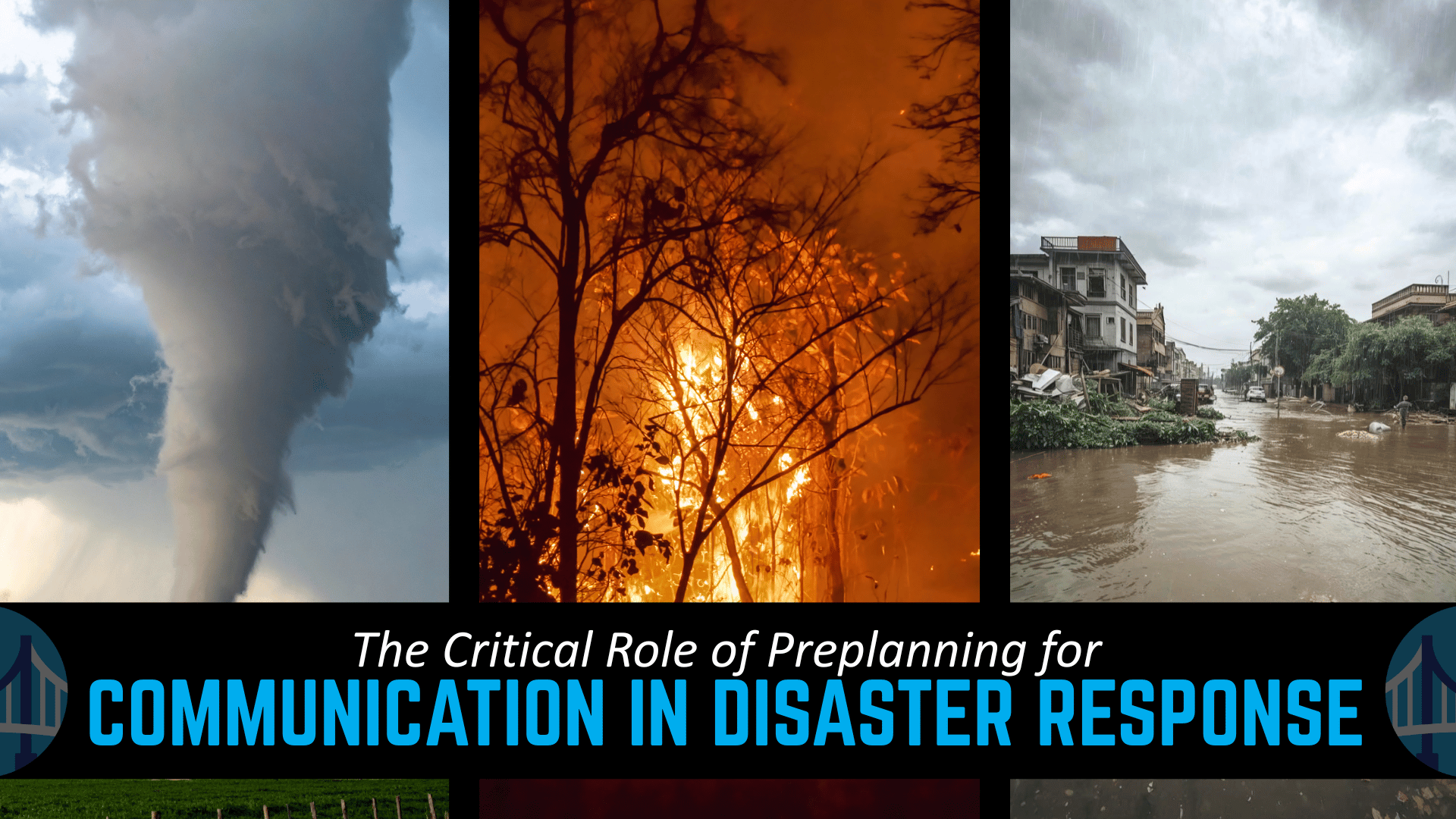
In disaster response, success is rarely determined by a single decision or moment. It is shaped long before an incident begins through deliberate preplanning for disaster response, especially in communications.
Public safety agencies invest years training on command structures, logistics, and tactical coordination. Yet one of the most heavily used communication methods during disasters remains largely unplanned, unsupported, and absent from formal doctrine: text-based messaging.
As disasters grow more complex, threats become more dynamic, and incidents increasingly span jurisdictions, this gap in communications in disaster response is becoming a serious operational risk.
The Communication Gap No One Wants to Acknowledge
Text-based messaging has quietly become one of the most relied-upon tools in public safety operations. Based on operational experience across large-scale incidents, special events, and disasters, text-based messaging now accounts for a significant portion of day-to-day and crisis communications.
Despite its widespread use, it has no formal role within the Incident Command System (ICS).
Voice communications are structured. Radio talkgroups are planned, assigned, trained, and exercised. ICS defines clear roles across operations, logistics, planning, and public information.
Text-based messaging, however, exists in a gray area. It is used constantly, but planned rarely. This disconnect introduces unnecessary risk during disasters, when clarity, speed, and accountability are essential.
Why Text Messaging Falls Outside ICS
Text messaging has historically been excluded from ICS, not because it lacks importance, but because traditional tools were never designed for operational command and control.
Consumer texting and group messaging platforms:
- Limit scalability and group size
- Require manual contact list maintenance
- Depend on the correct phone numbers being saved
- Persist conversations after personnel change roles or leave agencies
- Lack of governance, auditing, and role-based controls
- Often violates public records retention and security policies
These limitations make consumer texting impossible to operationalize within ICS. A communication method built on informal lists and ad hoc workflows cannot be effectively planned, exercised, or governed.
And yet, during disasters, agencies rely on it anyway.
Improvisation Is Not a Communications Strategy
Because ICS does not formally account for text-based communication, agencies are forced to improvise during disasters.
Supervisors create group texts on the fly. Command staff forward screenshots of updates. Teams exchange phone numbers during active incidents. Parallel conversations emerge with overlapping participants and conflicting information.
The outcome is predictable.
Communication failures consistently appear among the top findings in After-Action Reports following major disasters. Critical updates are missed. Information reaches the wrong people or not at all. Accountability becomes difficult, if not impossible.
In an era of severe weather events, civil unrest, mass casualty incidents, and infrastructure failures, this level of risk is unacceptable.
The Growing Complexity of Modern Disasters
Today’s disasters rarely remain confined to a single jurisdiction or operational period. Weather events can impact multiple regions over days. Civil unrest can spread rapidly. Wildfires, floods, and hurricanes demand coordination across law enforcement, fire, EMS, emergency management, communications, IT, and supporting agencies.
These incidents require sustained, multi-agency coordination that voice communications alone cannot support.
Text-based messaging is no longer supplemental. It is foundational to modern communications in disaster response.
Yet it remains the least planned component of emergency operations.
Preplanning for Disaster Response Must Include Messaging
Effective preplanning for disaster response requires acknowledging how operations actually function in the field, not how frameworks assume they function on paper.
Agencies meticulously plan radio usage. They assign channels, define protocols, and train personnel on when and how to communicate. These procedures are exercised repeatedly.
Text-based messaging deserves the same discipline. That includes defining:
- Who uses messaging and for what purpose
- Which information belongs in messaging versus voice
- How operational channels are structured and named
- How leadership communicates with personnel at scale
- How sensitive information is secured and audited
- How users are onboarded and removed as roles change
Without structure, messaging becomes a liability instead of an asset.
Bridge4PS Solves the Technology Problem. Planning Solves the Rest.
While national frameworks have yet to formally integrate digital messaging, Bridge4 Public Safety has already addressed the technology challenge.
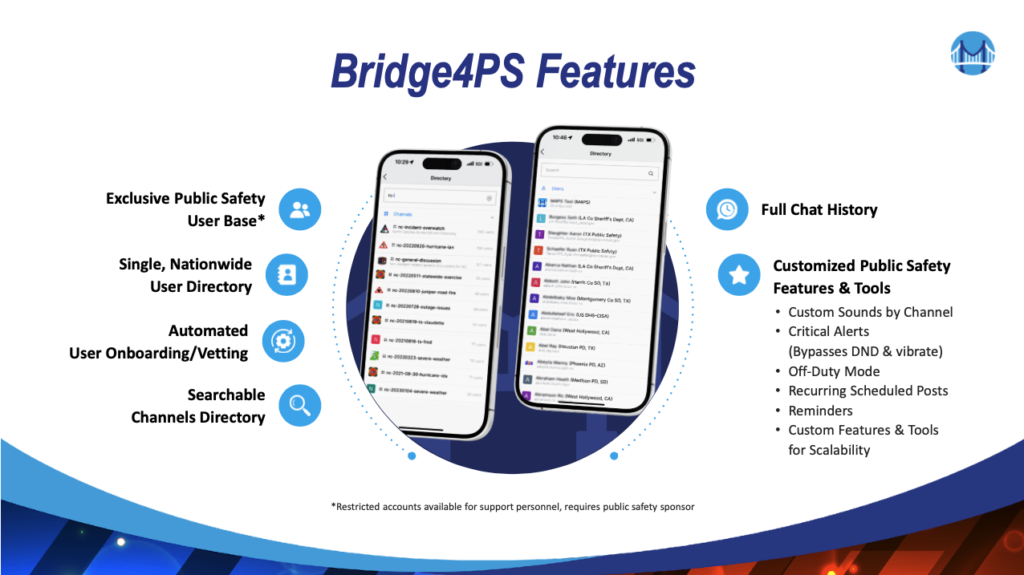
Bridge4PS delivers secure, scalable, real-time messaging built specifically for public safety operations. It replaces phone-number-based communication with a nationwide directory of verified users, role-based access controls, and persistent operational channels aligned to agency and ICS structures.
It is compliant, auditable, and designed for both daily operations and high-stakes disaster response.
However, technology alone is not enough.
Agencies that see the greatest impact pair Bridge4PS with clear Concepts of Operations and Standard Operating Procedures. This brings discipline and structure to digital messaging, just as they have done for radio communications, logistics, and resource management.
Building Muscle Memory Before the Crisis
One of the most consistent lessons from real-world disasters is that tools must be used daily to perform effectively during crises.
When messaging platforms are only introduced during disasters, responders waste valuable time learning workflows under pressure. That is avoidable.
Preplanning for disaster response means using the same communication tools for routine operations, training, and coordination. This builds familiarity, confidence, and muscle memory.
When disaster strikes, personnel focus on the mission, not the mechanics of communication.
Leadership Cannot Wait for Doctrine to Catch Up
ICS has evolved over decades, often in response to tragedy. Waiting for formal frameworks to catch up to operational reality is a risk public safety cannot afford.
Leadership today means acknowledging how communications in disaster response actually occur and taking action now.
That leadership includes:
- Recognizing messaging as operational infrastructure
- Selecting tools designed for multi-agency public safety operations
- Developing clear SOPs for digital communication
- Training and exercising those procedures regularly
This proactive approach closes one of the most dangerous gaps in disaster response.
Preplanning Is How Communication Failure Is Prevented
Disasters will remain unpredictable. Threats will evolve. Weather events will intensify.
What does not need to remain unpredictable is communication.
By prioritizing preplanning for disaster response and treating text-based messaging as mission-critical infrastructure, agencies can reduce chaos, improve coordination, and better protect responders and the communities they serve.
The cost of inaction is already documented. The path forward is clear.
Preplanning is no longer optional. It is the difference between response and reaction.